
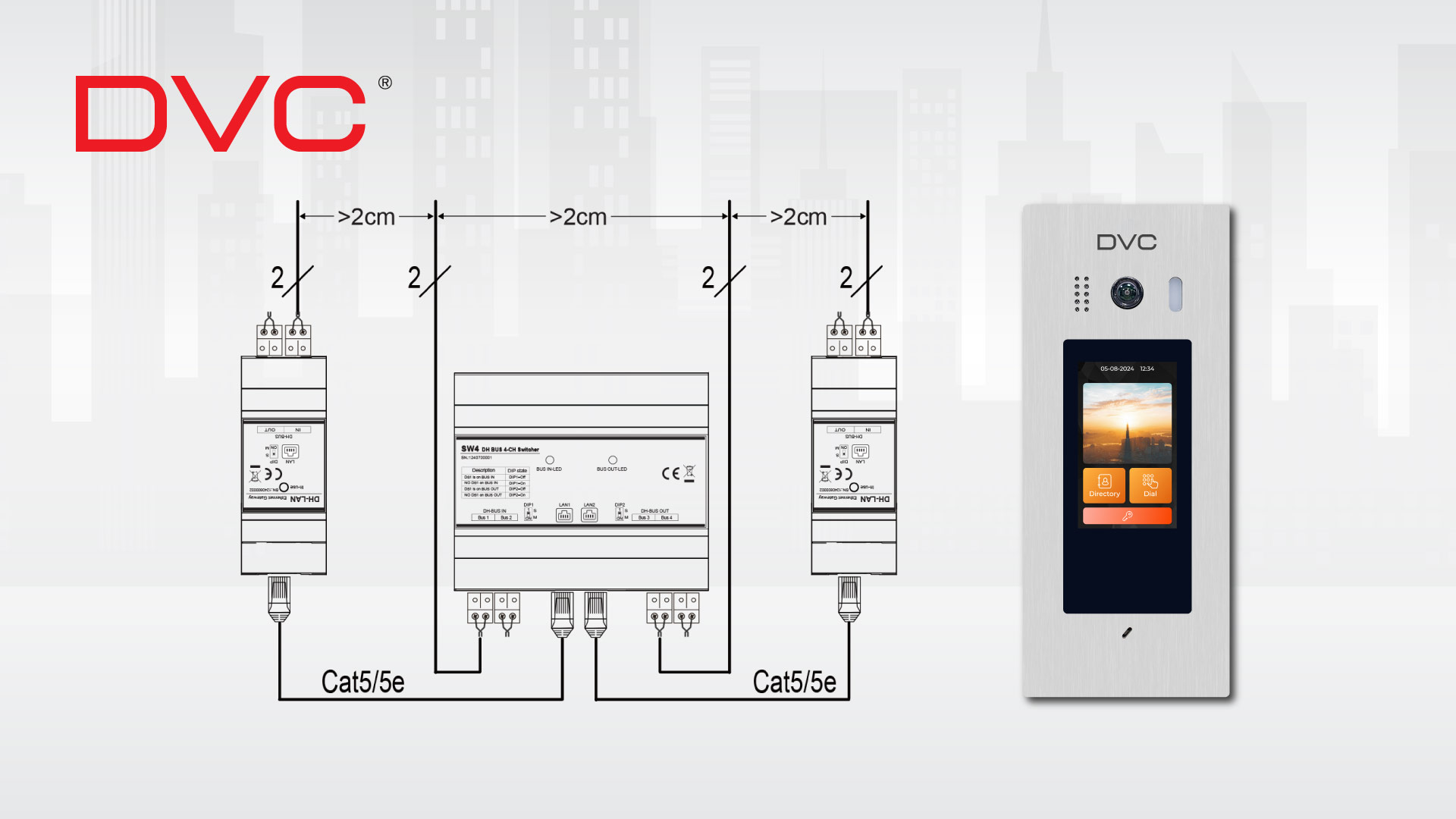
Important technical notice for all DH system installer partners
To help our B2B partners and installers with the planning and execution of projects based on the DVC DH system, below we provide a brief but important technical overview of the system’s capabilities, expansion options, and key wiring rules. Proper installation is essential for stable system operation, optimal video and audio quality, and long-term reliability in real-world operating conditions.
The DH system is a digital two-wire system which, compared to analogue solutions, offers significantly better video and audio quality, greater functionality, and all the advantages of a modern digital (IP) system.
To enable IP data transmission over just two wires, the DH system uses a special high-frequency RF signal. Due to this technology, one basic system block is limited to a maximum of 20 devices, specifically:
- up to 4 door station units
- up to 16 indoor monitors
System expansion
For projects that require a higher number of devices than the basic limitation allows, system expansion modules are used:
- DVC DH-SW4
- DVC DH-LAN
By using these modules, it is possible to build larger and more complex systems. However, it is extremely important to strictly follow installation rules in order to avoid interference and signal cross-talk.
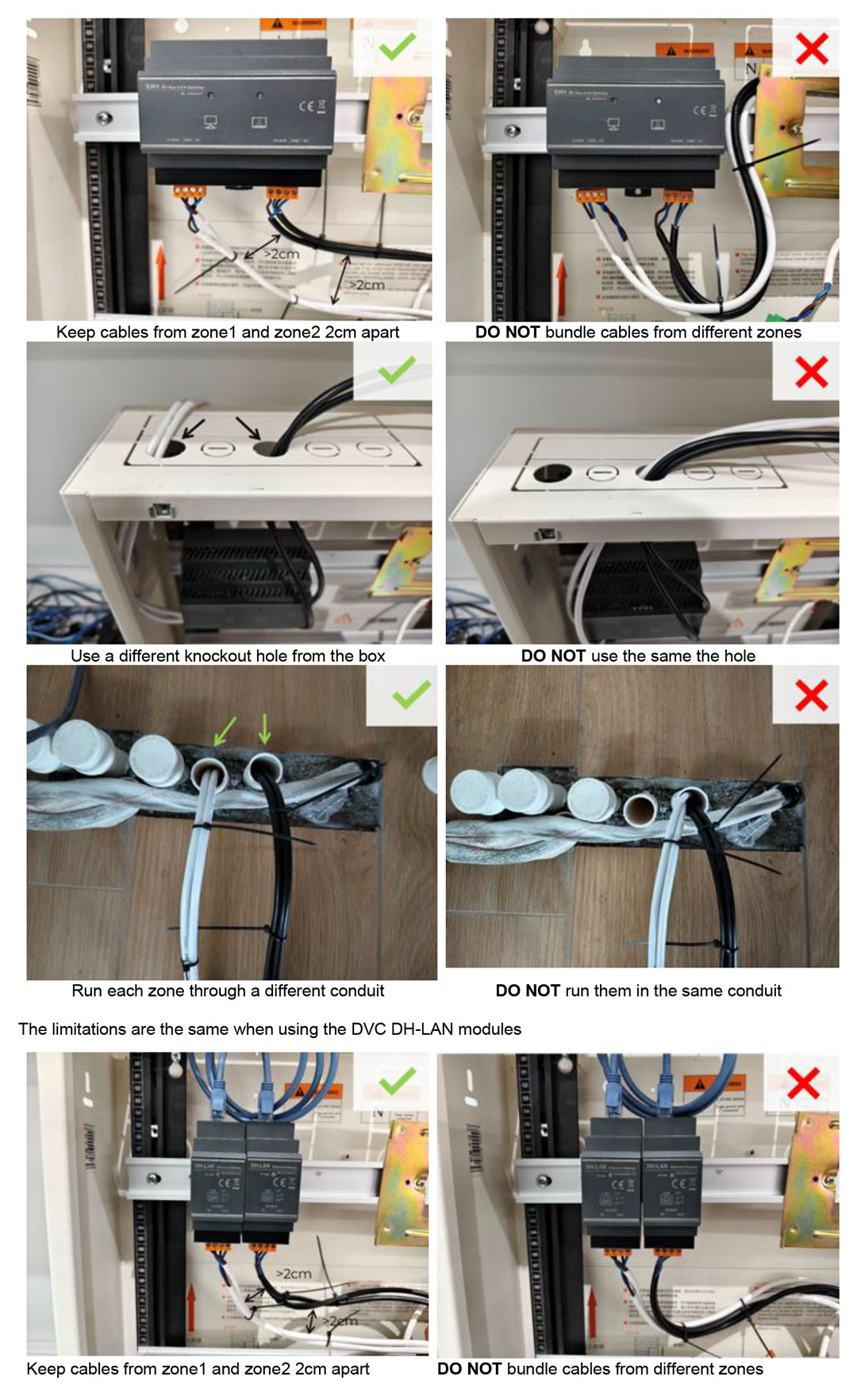
Wiring rules
Due to the use of a high-frequency RF signal, proper planning and execution of the cable infrastructure are critical for stable system operation.
Within a single zone
Within the same zone, the installer has complete freedom in choosing the wiring topology. The following are permitted:
- star topology
- in-out (daisy-chain) wiring
- a combination of different topologies
The wiring method can be adapted to the actual site conditions and project requirements.
Between two zones
When connecting multiple zones, strict rules regarding physical cable separation must be followed:
- cables from Zone 1 and Zone 2 must be physically separated along their entire route
- they must not be bundled or tied together
- they must not be routed through the same conduit or cable channel
- a minimum separation of 2 cm must be maintained between cable runs of different zones
These rules apply to the entire cable route, including walls, ceilings, conduits, and distribution cabinets.
Following these guidelines ensures stable operation of the DVC DH system, maximum transmission quality, and reliable performance even in larger and more complex installations. For additional technical information or design assistance, our technical team is at your disposal.